AI-Sorted Collections Delivered 137.5% Higher Conversions in April 2026 — Here’s the Full Breakdown
Every product collection page on your Shopify store is quietly making a decision for your customers: what to look at first, what to consider next, and what to skip entirely. Most stores leave that decision to Shopify’s default sorting — alphabetical, best-selling, or manual arrangements that don’t adapt to real-time shopper behavior. And every month, the data tells us the same story: that’s leaving money on the table.
In April 2026, Dynasort tracked over 6.1 million collection page sessions across thousands of active Shopify stores. The results reinforce what we’ve seen month after month — AI-driven collection sorting meaningfully outperforms static defaults across every key shopping behavior metric. This report breaks down exactly what happened, what the numbers mean, and why it matters for your bottom line.
Key Metrics: How Dynasort Collections Performed Against Shopify Defaults
We measure Dynasort’s impact by comparing shopping behavior on collections actively sorted by our AI against collections using Shopify’s default sorting logic. Here’s how April 2026 shook out:
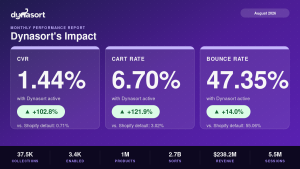
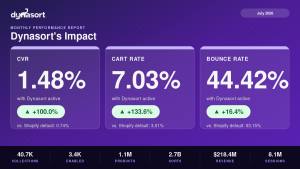
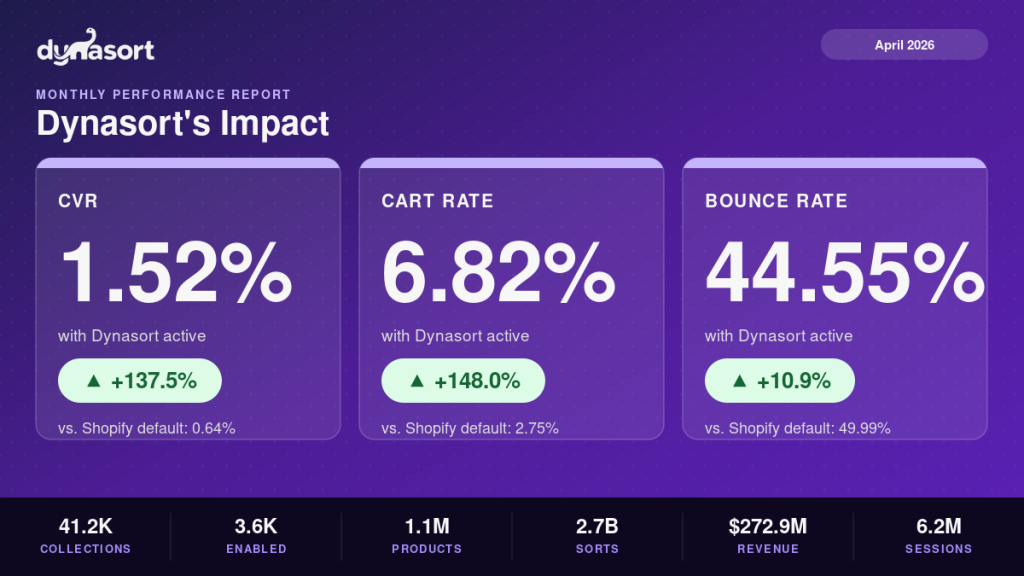
Conversion Rate (CVR): 1.52% vs. 0.64% — a 137.5% improvement
This is the metric that matters most. Conversion rate measures the percentage of collection page visitors who ultimately completed a purchase. Dynasort collections converted at 1.52%, compared to 0.64% on default-sorted collections. That’s not a marginal gain — it’s more than double the conversion rate.
What’s driving this? When your collection page surfaces the right products for each visitor based on real behavioral signals — not just static rules — shoppers find what they want faster and buy with more confidence. A 137.5% CVR improvement means that for every 1,000 visitors hitting a Dynasort-sorted collection, roughly 9 more customers are completing a purchase than they would on a default page. Scale that across thousands of daily sessions and the revenue impact compounds quickly.
Cart Rate: 6.82% vs. 2.75% — a 148% improvement
Cart rate tracks how often visitors add a product to their cart from a collection page. In April, Dynasort collections saw a 6.82% cart rate versus 2.75% for Shopify defaults — a 148% improvement and our strongest-performing metric this month.
This number reflects purchase intent. When more people are adding to cart, it means the products they’re seeing first are relevant, appealing, and well-matched to what they came looking for. A higher cart rate also feeds your abandoned cart recovery flows, giving you more opportunities to close sales even when shoppers don’t buy immediately.
Exit Rate: 58.58% vs. 61.35% — a 4.52% improvement
Exit rate measures the percentage of visitors whose last pageview was the collection page — meaning they left your store entirely without navigating deeper. Dynasort collections held that number to 58.58%, compared to 61.35% on default-sorted pages.
A 4.52% improvement here might sound modest compared to the CVR and cart rate numbers, but consider what it represents at scale: across millions of sessions, that’s tens of thousands of additional shoppers staying on your site, browsing product pages, and moving further into your funnel instead of bouncing to a competitor.
Bounce Rate: 44.55% vs. 49.99% — a 10.88% improvement
Bounce rate captures single-page sessions — visitors who landed on a collection page and left without any further interaction. Dynasort-sorted collections reduced bounce rate by 10.88%, from nearly 50% down to 44.55%.
This tells us something important about first impressions. When a shopper lands on a collection page and immediately sees products that feel relevant, they engage. When they see a poorly ordered wall of products that doesn’t match their intent, they leave. Nearly an 11% improvement in bounce rate means Dynasort is doing its job in that critical first moment.
Platform Scale: Dynasort by the Numbers
April 2026 was another month of significant scale across the platform:
- 41,197 collections tracked across all connected stores, with 3,561 collections actively sorted by Dynasort’s AI
- 1,088,209 products managed — over a million SKUs being intelligently positioned in real time
- 2.65 billion collection sorts executed during the month, meaning our algorithms continuously re-optimized product order based on fresh behavioral data
- $272.9 million in catalog revenue managed, representing the total product value across stores relying on Dynasort
- 6,150,039 total collection sessions analyzed, providing the robust data foundation behind every number in this report
These aren’t theoretical projections. Every metric in this report is drawn from real sessions, real shopping behavior, and real purchase outcomes across a diverse base of Shopify merchants.
What This Means for Merchants
If you’re running a Shopify store, here are the practical takeaways from April’s data:
Your collection page order is a conversion lever — treat it like one. Most merchants obsess over ad creative, landing pages, and checkout optimization. Collection page sorting rarely gets the same attention, yet it directly influences whether shoppers find products they want to buy. The 137.5% CVR gap suggests this is one of the highest-impact, lowest-effort optimizations available.
More add-to-carts means more recovery opportunities. Even if your conversion rate stays flat, a 148% improvement in cart rate dramatically expands your remarketing and abandoned cart audiences. Every add-to-cart is a signal of intent that your email and SMS flows can act on.
Reducing bounce and exit rates has compounding effects. Shoppers who stay on your site longer see more products, build more brand familiarity, and are more likely to return — even if they don’t purchase today. Lower bounce rates also send positive engagement signals that can benefit your SEO and paid ad quality scores over time.
You don’t need to manage this manually. Dynasort executed over 2.6 billion sort operations in April alone. No merchandising team can match that frequency or responsiveness. The AI adapts continuously to shifting customer behavior, seasonal trends, and inventory changes without requiring you to touch a thing.
Ready to See What Smarter Sorting Can Do for Your Store?
The gap between AI-optimized and default-sorted collections isn’t narrowing — it’s consistent, measurable, and significant. If your collection pages are still relying on Shopify’s built-in sorting, April’s data makes a strong case for change.
Try Dynasort free and let your collections start working harder — automatically.