AI-Sorted Collections Delivered 129% Higher Conversions in May 2026 — Here’s the Full Breakdown
Every product in your Shopify collection has a position. And that position is either working for you or against you. When a customer lands on a collection page, the order of your products determines whether they scroll, click, add to cart, or leave. Most stores still rely on Shopify’s default sorting — manual arrangements, alphabetical order, or basic “best selling” logic that updates slowly and doesn’t adapt to real-time shopping behavior.
Dynasort exists to fix that. Our AI engine continuously re-sorts your product collections based on live performance data, putting the right products in front of the right shoppers at the right time. Every month, we publish a transparent performance report comparing Dynasort-sorted collections against Shopify’s default sorting across the same stores. May 2026 was our strongest month yet — and the numbers tell a clear story about what intelligent merchandising can do for your bottom line.
Key Metrics: Dynasort vs. Shopify Default Sorting
We measure four core shopping behavior metrics across every collection session. Here’s how Dynasort-enabled collections performed against Shopify’s default sorting in May 2026.
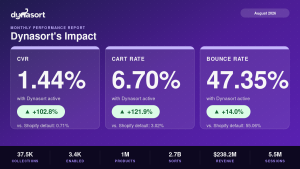
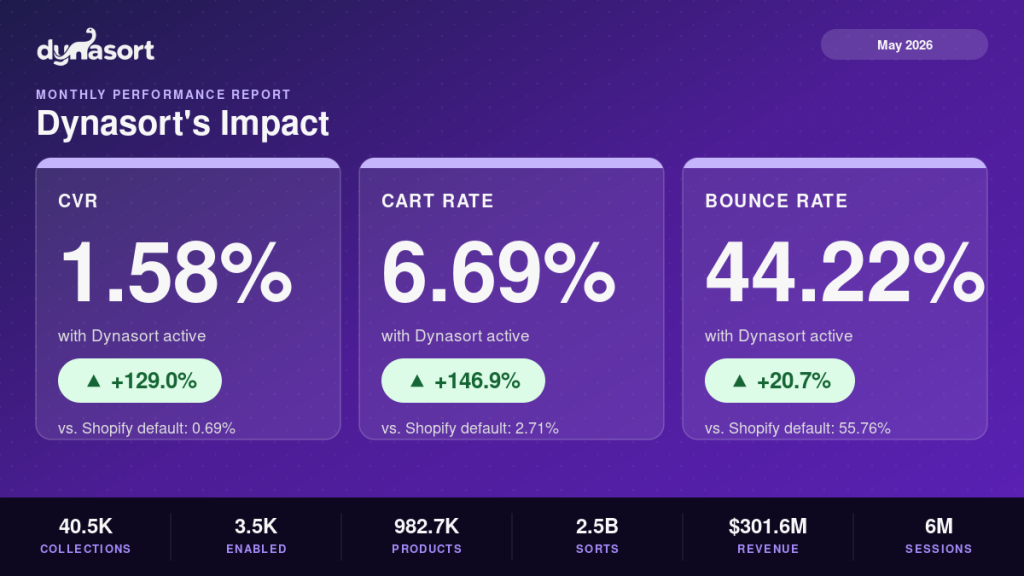
Conversion Rate (CVR): 1.58% vs. 0.69% — 129% Improvement
Conversion rate is the metric that matters most. It measures the percentage of collection visitors who complete a purchase. Dynasort collections converted at 1.58%, compared to 0.69% for default-sorted collections — a 128.99% improvement. To put that in plain terms: for every 1,000 visitors landing on a collection page, Dynasort-sorted collections generated roughly 9 additional purchases compared to the default. At scale, that’s transformative. This isn’t the result of driving more traffic or running steeper discounts. It’s the same products, the same collection pages, just sorted more intelligently.
Cart Rate: 6.69% vs. 2.71% — 147% Improvement
Cart rate tracks the percentage of collection visitors who add at least one product to their cart. This is the clearest signal of purchase intent, and it’s where Dynasort showed its largest advantage in May. Dynasort collections achieved a 6.69% cart rate, more than double the 2.71% rate on default-sorted collections — a 146.86% improvement. When products that match a visitor’s likely preferences appear higher in the collection, the friction between browsing and buying drops dramatically. More adds-to-cart means a fuller pipeline for your checkout flow, your abandoned cart emails, and your retargeting campaigns.
Exit Rate: 59.18% vs. 66.78% — 11.38% Improvement
Exit rate measures how often a collection page is the last page a visitor sees before leaving your store entirely. A high exit rate means your collection page is a dead end rather than a gateway. Dynasort reduced exit rate from 66.78% to 59.18% — an 11.38% improvement. That means more visitors continued browsing your store after viewing a Dynasort-sorted collection. They clicked into product pages, explored other collections, or moved toward checkout. Fewer exits mean more opportunities to convert on every session.
Bounce Rate: 44.22% vs. 55.76% — 20.7% Improvement
Bounce rate captures the percentage of visitors who land on a collection page and leave without interacting at all — no clicks, no scrolls, no engagement. Dynasort brought bounce rate down from 55.76% to 44.22%, a 20.7% improvement. This metric speaks directly to first impressions. When the first rows of a collection feature products that are relevant, visually compelling, and aligned with current demand, visitors stay. When they see stale or irrelevant products, they leave. Dynasort’s AI ensures that first impression is optimized continuously.
Platform Scale: May 2026 by the Numbers
Dynasort’s performance data isn’t drawn from a small test group. In May 2026, our platform operated at significant scale:
- 40,512 collections tracked across all connected stores
- 3,548 collections actively sorted by Dynasort’s AI engine
- 982,742 products managed across the platform
- 2.49 billion sort operations executed — every sort reflecting real-time data analysis
- $301.6 million in catalog revenue managed across Dynasort-enabled stores
- 6.02 million total collection sessions analyzed
These numbers reflect a platform that’s processing massive volumes of merchandising decisions every day. Each of those 2.49 billion sorts represents Dynasort’s AI evaluating product performance signals, identifying patterns, and repositioning products to maximize engagement and revenue. The performance improvements reported above aren’t theoretical — they’re drawn from over six million real shopping sessions across nearly a billion dollars in managed catalog value.
What This Means for Merchants
If you’re running a Shopify store, here are the practical takeaways from this month’s data:
Your collection sort order is a conversion lever. Most merchants spend heavily on traffic acquisition — ads, SEO, influencer partnerships — but neglect what happens when that traffic actually arrives. Collection page sorting is one of the highest-leverage, lowest-cost optimizations available to you. The data shows it can more than double your conversion rate.
Default sorting is leaving money on the table. Shopify’s built-in sorting options are functional, but they’re static. They don’t learn from visitor behavior, they don’t adapt to inventory changes in real time, and they don’t differentiate between a first-time visitor and a returning customer. The 129% CVR gap and 147% cart rate gap in May’s data represent the cost of that rigidity.
The impact compounds. Better sorting doesn’t just improve one metric in isolation. Lower bounce rates feed into higher cart rates, which feed into higher conversions, which feed into better revenue per session. When your collection pages keep visitors engaged from the first scroll, every downstream metric benefits.
Start Sorting Smarter
May 2026 reinforced what our data has shown month after month: AI-driven collection sorting meaningfully outperforms the default across every metric that matters to your store’s profitability. The stores using Dynasort aren’t working harder — they’re letting their product data work harder for them.
Ready to see what smarter sorting can do for your store? Try Dynasort free on the Shopify App Store and let your collections start optimizing themselves.