AI-Sorted Collections Delivered 92.65% Higher Conversion Rates in June 2026
Every Shopify store owner knows the feeling. You’ve spent money driving traffic, your products are solid, your photos look great — but visitors land on a collection page and leave without buying. The problem often isn’t what you’re selling. It’s the order you’re showing it in.
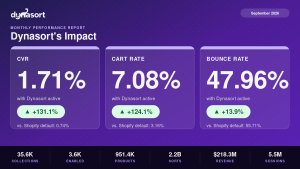
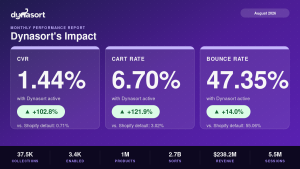
June 2026 marked another strong month for Dynasort merchants, and the data tells a compelling story. Across over 5.6 million collection page sessions, stores using Dynasort’s AI-powered sorting consistently outperformed default Shopify sorting on every key metric — from conversion rate to bounce rate. Below, we’ll break down exactly what these numbers mean and why they matter for your bottom line.
Key Metrics: Dynasort vs. Default Shopify Sorting
We measure Dynasort’s performance by comparing shopping behavior on collections where our AI sorting is active against collections using Shopify’s default sort order. Here’s how June 2026 shook out.
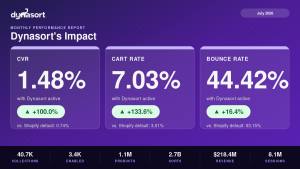
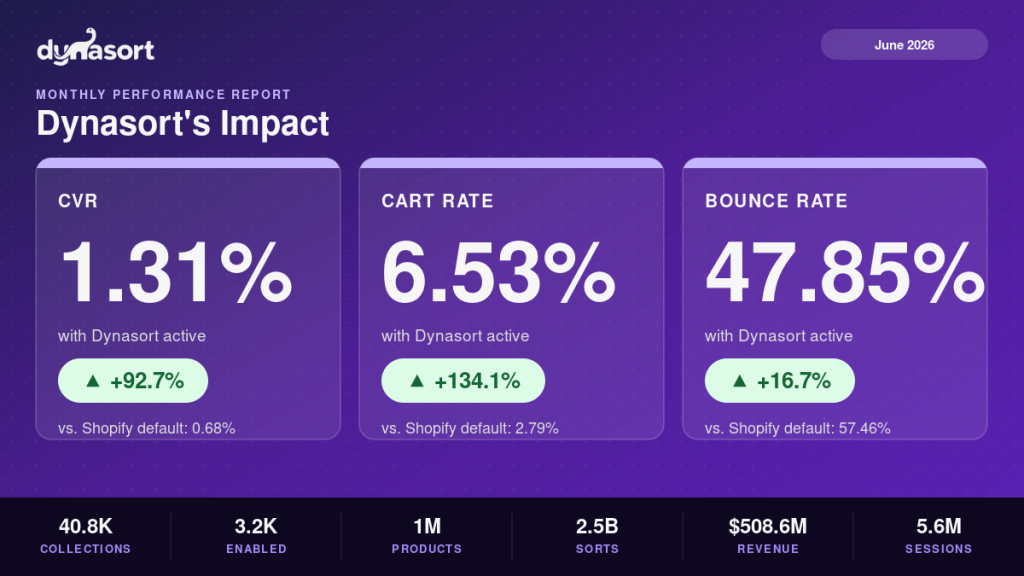
Conversion Rate (CVR): 92.65% Improvement
Dynasort: 1.31% → Shopify Default: 0.68%
Conversion rate is the metric that pays the bills. It measures the percentage of collection page visitors who complete a purchase. In June, Dynasort collections converted at nearly double the rate of default-sorted collections — a 92.65% improvement.
To put that in practical terms: for every 1,000 visitors to a default-sorted collection, roughly 7 people buy. With Dynasort, that number jumps to 13. At scale, that difference represents significant revenue without spending a single additional dollar on advertising.
Cart Rate: 134.05% Improvement
Dynasort: 6.53% → Shopify Default: 2.79%
Cart rate tracks the percentage of visitors who add at least one product to their cart from a collection page. This was Dynasort’s strongest metric in June, with AI-sorted collections seeing a 134.05% higher add-to-cart rate.
This metric matters because it captures buying intent upstream. Even visitors who don’t complete checkout in that session have entered your funnel. They’re remarketing candidates. They’ve shown interest. A higher cart rate means more opportunities to close sales — now or later.
Exit Rate: 8.4% Improvement
Dynasort: 61.83% → Shopify Default: 67.5%
Exit rate measures the percentage of visitors for whom a collection page was the last page they viewed before leaving your store. A lower exit rate means more visitors continue browsing deeper into your site.
Dynasort collections saw an 8.4% reduction in exit rate compared to default sorting. That might sound modest next to the cart rate numbers, but think about what it represents: thousands of additional visitors each month who stayed on your store instead of leaving. Every one of those visitors is another chance to make a sale.
Bounce Rate: 16.72% Improvement
Dynasort: 47.85% → Shopify Default: 57.46%
Bounce rate tracks single-page sessions — visitors who land on a collection page and leave without interacting further. In June, Dynasort collections reduced bounce rate by 16.72%.
High bounce rates are expensive. You paid to get that visitor to your store, and they left immediately. When AI sorting puts the most relevant products in front of shoppers from the first scroll, they’re more likely to engage. A nearly 10-percentage-point drop in bounce rate means substantially more of your paid and organic traffic is actually working for you.
Platform Scale: June 2026 by the Numbers
Dynasort’s performance data isn’t based on a handful of test stores. Here’s the scale behind the numbers:
- 40,768 collections tracked across the Dynasort platform
- 3,150 collections actively sorted by Dynasort’s AI
- 1,024,832 products managed across all connected stores
- 2.48 billion collection sorts executed — the cumulative number of times Dynasort’s algorithm has optimized product order
- $508.6 million in catalog revenue managed across Dynasort-connected stores
- 5,623,928 total collection sessions recorded in June
These aren’t projections or lab results. This is real shopping behavior from real customers across a diverse range of Shopify stores managing over half a billion dollars in catalog value.
What This Means for Merchants
The takeaway from June’s data is straightforward: the order your products appear in directly affects whether people buy them.
Default Shopify sorting options — alphabetical, best-selling, newest, price — are static. They don’t adapt to what’s actually converting. Dynasort’s machine learning analyzes real-time shopping behavior and continuously re-sorts your collections to surface the products most likely to lead to a purchase.
Here’s what that means in practice:
- You get more revenue from existing traffic. No increased ad spend required. The visitors you’re already paying for simply convert at a higher rate.
- Your ad spend becomes more efficient. When more visitors add to cart and fewer bounce, your cost per acquisition drops.
- It compounds over time. Dynasort’s algorithm learns continuously. As it processes more data from your store, its sorting decisions become more precise.
The merchants seeing the best results aren’t doing anything complicated. They install the app, enable it on their collections, and let the AI do what static sort rules can’t — adapt in real time.
Start Sorting Smarter
June 2026 reinforced what months of data have consistently shown: AI-sorted collections outperform default sorting across every metric that matters to your business.
If you’re still relying on manual or default sort orders for your Shopify collections, you’re likely leaving conversions on the table.
Try Dynasort free and see what smarter sorting does for your store.