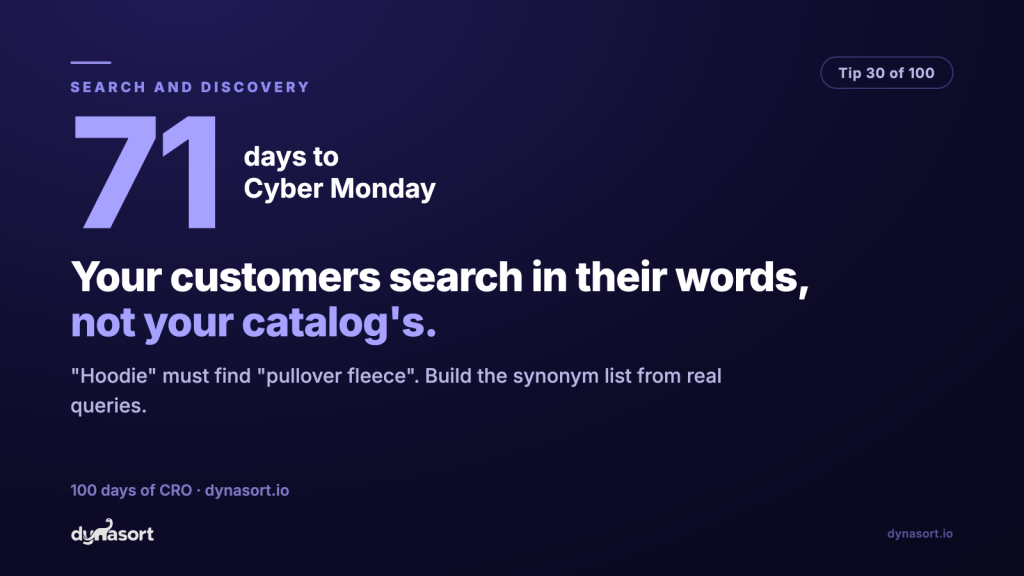
Search synonyms exist because your customers search in their words while your catalog is written in yours, and the gap between those two vocabularies is a quiet daily leak. The shopper types “hoodie”. Your product is a “pullover fleece”. The search returns nothing, the shopper concludes you do not sell hoodies, and they leave to buy one from someone whose copywriter was less creative. Nobody logs a complaint. The sale just does not happen.
This is a naming-culture problem, and it is universal. Merchants name products the way parents name children: with love, aspiration, and zero regard for searchability. Customers name products the way they talk. “Sneakers” vs your “trainers”. “Couch” vs your “sofa”. “Swimsuit” vs your “bathing suit”. “Phone case” vs your “device sleeve”. Regional English alone, US vs UK vs Australia, will torpedo a search box that only knows one dialect.
The translation layer
A synonym list is a dictionary between how buyers talk and how your catalog is written. Every row rescues real searches.
The arrows only point one way in the search engine’s mind, so map both directions where it matters: “sofa” should find couches too.
Build the dictionary from evidence
Do not brainstorm synonyms in a meeting; harvest them. You read your search logs in tip 17, and the raw material is sitting right there: every query with zero or weak results that should have matched something you sell is a synonym candidate with proof of demand attached. Add the misspellings you see repeatedly, the brand-name genericisms of your niche, and the regional variants for every country you ship to.
On Shopify, the free Search & Discovery app lets you define synonym groups for storefront search, and most dedicated search tools have an equivalent screen. The mechanics take an afternoon. The discipline is the monthly loop: new zero-result queries in, new synonym rows out, forever, because your customers’ vocabulary keeps evolving even when your catalog does not.
One more source hiding in plain sight: your product copy itself. If the words customers use appear in your descriptions and tags (“a hoodie you will live in all winter”), many search engines match without any synonym rule at all. Writing product copy in customer language is the synonym list you never have to maintain, and it converts better for the humans reading it too.
Searchers are your highest-intent visitors, you measured that multiple back in tip 5. A synonym list is twenty minutes of translation work that stops telling them “no results” when the answer was “aisle three, under a different name”.