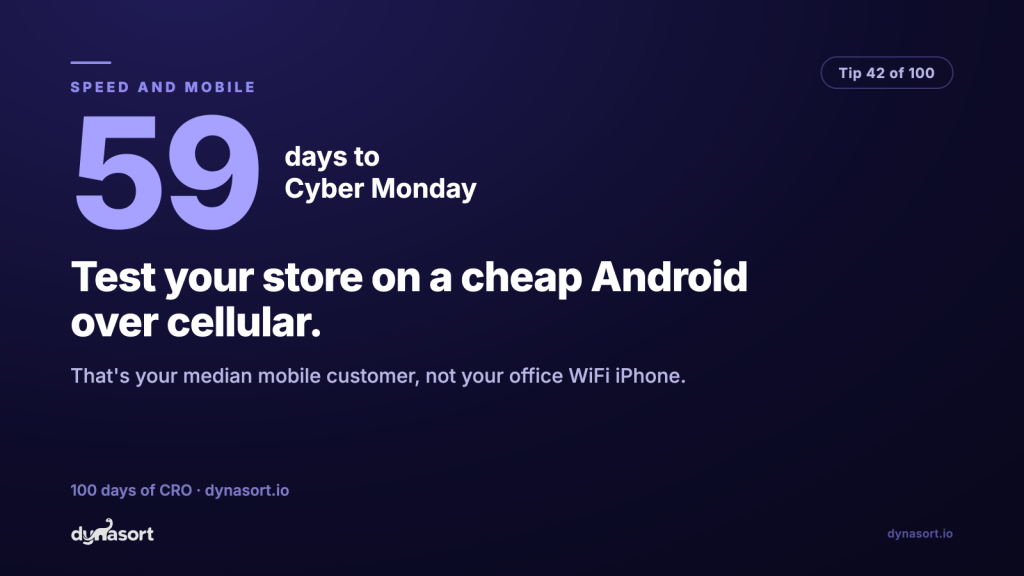
Mobile site speed testing on a cheap Android over a cellular connection will tell you more about your store than any dashboard, because that device is your median mobile customer. You experience your store on a flagship phone, on office WiFi, with every image already cached from the hundred times you have opened it this week. That experience is real for exactly one visitor: you.
Meanwhile the shopper who found you on Instagram is holding a $150 Android, three years old, on two bars of LTE in a parking lot. Budget hardware means slower processors, and processing is where modern storefronts hurt: every script your theme and apps ship gets parsed and executed by that modest chip. A page that feels instant on your phone can take three times as long to become tappable on theirs, and they do not know your store is “usually faster.” They only know this tab is not loading and the back button is right there.
The ritual, once a month
- Get the device. Buy a sub-$200 Android, used is fine, and keep it in a drawer as your store’s crash-test dummy. It may be the highest-ROI hardware your business owns.
- Turn off WiFi. Cellular only, ideally somewhere with mediocre signal. Clear the browser cache so you load the store the way a first-time visitor does, cold.
- Shop for real. Homepage, a collection, search for something, product page, add to cart, reach checkout. Feel where you wait, where you mis-tap, where the layout jumps as late images shove the button you were aiming at.
- No spare phone this week? PageSpeed Insights already simulates a mid-tier device for its mobile score, and Chrome DevTools can throttle the network and CPU to approximate the same pain. Useful, and still not a substitute for thumb-on-glass reality.
The lab numbers and the LCP work from tip 4 remain your instruments. But instruments are for measuring; the drawer phone is for believing. Nothing reprioritizes a roadmap like watching your own checkout take eleven seconds in your own hands.
Fifty-nine days out is the moment for this test, because whatever you find still has time to get fixed, and Cyber Monday traffic skews harder toward mobile, first-time visitors, and strained networks than any other day of your year. Your median customer is about to get even more median. Meet them where they shop.