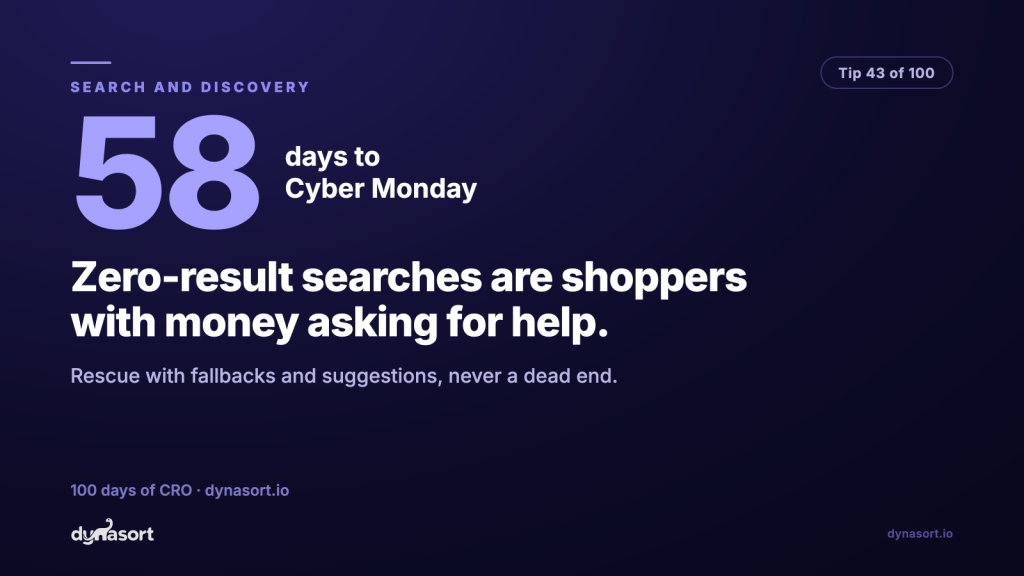
Zero-result searches are the highest-intent failures on your entire store. Think about who types into a search box: someone who knows roughly what they want, described it in their own words, and asked you directly. Tip 40 had you measure how much better those people convert. And your store’s response to some of them, right now, is a blank page and a shrug: “0 results for ‘jogers’.” That is a salesperson watching a customer walk in, ask for joggers, and walking away without a word.
The infuriating part is that the store usually has the product. Zero-result pages are mostly vocabulary accidents: a typo, a synonym you never mapped (tip 30), a singular where your title is plural, a brand name spelled from memory. The shopper did nothing wrong. The catalog did nothing wrong. The translation layer failed, and the default failure mode is a dead end.
Anatomy of a rescue
The rule: the results page may say “no exact matches,” but it must never be empty. Something relevant, something clickable, always.
Same query, two stores
A shopper searches “jogers”. One store ends the conversation. The other keeps selling.
Try another search.
“No exact matches” is allowed. An empty page is not.
Build the net, then shrink the hole
- Layer the fallbacks. Spelling suggestion first, then relaxed matching on partial terms, then bestsellers with an honest “no exact matches, but shoppers love these.” Each layer catches what the one above missed. On our own platform this is codified as a rule: when a query in Dynasort-served search comes back empty, we automatically widen the match rather than serve the blank page, because a dead end is the one result we refuse to return.
- Add a human exit. A “can’t find it? Ask us” link on the zero-results page turns your worst page into a support lead with purchase intent attached.
- Fix the causes upstream. Your zero-result query log is a to-do list: every recurring failed term is either a synonym to add (tip 30), a product to stock, or a category you should stop assuming people can spell.
A shopper who searches is asking to be sold to. Answer every time, even when the answer starts with “not exactly, but.”