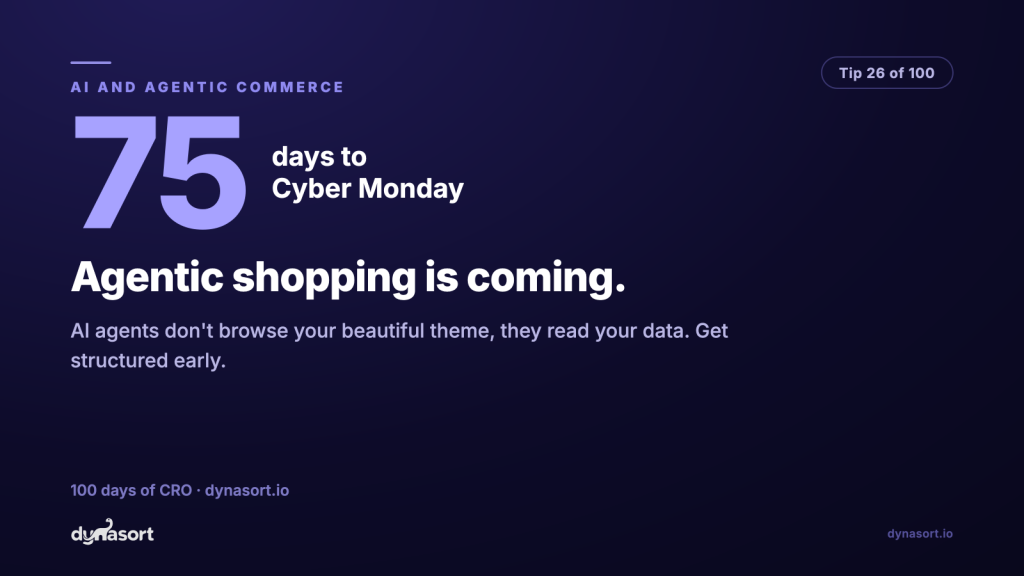
Agentic shopping, where an AI assistant researches and shortlists products on a customer’s behalf, is moving from demo to habit, and it changes a foundational assumption of your store: that the entity doing the shopping has eyes. People already ask ChatGPT, Claude, Perplexity, and Gemini “what should I buy” questions every day, and the assistants answer by reading the web, including your store. The next step, agents that compare, shortlist, and hand a human a filled cart, is being built by every major platform right now.
Here is the uncomfortable part. An agent does not see your beautiful theme. It does not feel the hero video, admire the color story, or scroll your lovingly art-directed lookbook. It reads your data: titles, descriptions, prices, variants, availability, reviews, policies, structured markup. Two decades of visual merchandising instinct, and the newest customer in the room is functionally blind. The stores that win agent-mediated sales will be the ones whose product data answers questions without a human squinting at photos.
Same product page, two shoppers
The human gets the theme. The agent gets the data. Only one of these views is usually maintained with care.
“price”: “129.00”
“availability”: “InStock”
“material”: missing
“weight”: missing
“waterproof”: in a photo caption
Every “missing” is a comparison your product silently loses to a competitor whose data answered the question.
Getting structured early
- Get the facts out of the photos. If the material, dimensions, weight, or compatibility only exist in an image or a lifestyle caption, they do not exist to an agent. Put every buying-decision fact in the description or, better, in metafields.
- Check your structured data. Most Shopify themes emit schema.org Product markup with price and availability; verify yours does, and that it is not stuck on placeholder values from a theme customization long ago.
- Write titles that identify, not just seduce. “Midnight Wanderer” is a mood; “Midnight Wanderer Wool Overshirt, Navy” is an answer. Agents match on the second half.
- Keep policies findable in text. Shipping costs, return windows, and warranty terms are exactly what an agent checks before shortlisting you. A policy that lives in a checkout FAQ image might as well not exist.
The good news: none of this is wasted if agentic shopping arrives slower than the keynotes promise. Structured, complete, honest product data is also what Google Shopping ranks on, what your own site search matches on, and what your human customers skim for. Preparing for the customer without eyes makes the store better for the ones with them. Start with your top ten products this month.