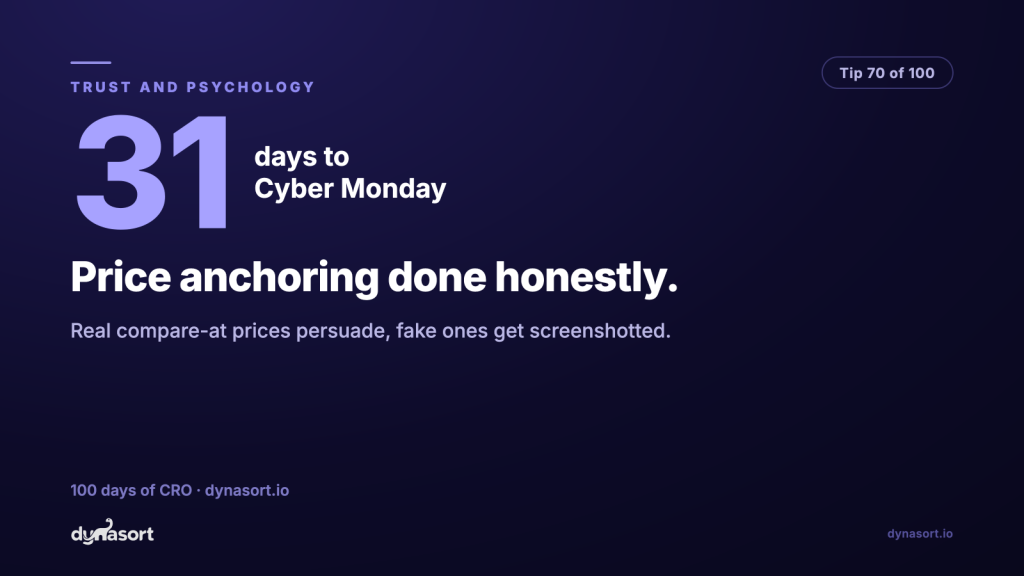
Price anchoring works because a price has no meaning until it stands next to another price. $69 is just a number; “$89, now $69” is a story with a hero. Shopify hands you the mechanism in the compare-at price field, and used honestly it is one of the most reliable persuasion tools in commerce. Used dishonestly, it is a screenshot waiting to happen.
The dishonest version is everywhere, and shoppers have learned its smell: the “was $199” that has said $199 since the product launched, the sale that ends every Sunday and restarts every Monday, the compare-at price no customer has ever actually paid. This is not a gray area. Inflated reference prices are the kind of thing consumer protection regulators bring cases over, and the private punishment arrives faster than the legal one: your “permanent sale” ends up in a Reddit thread, a review, or a competitor’s ad, and every future discount you offer, including the real ones, gets read as theater.
Two anchors, one smell test
Identical markup on the page. Completely different stories underneath.
An anchor is a claim about the past. Shoppers, price trackers, and regulators can all check it.
Anchoring honestly, and still anchoring hard
- Only compare-at prices you actually charged. The rule fits in one sentence: if a real customer did not pay it in recent memory, it does not belong in a strikethrough.
- Give every discount a story and an expiry. “End of season”, “bundle pricing”, “launch week”. A reason makes the deal legible; an ending makes it credible. Then actually end it.
- Anchor with your own range. The cleanest anchoring needs no strikethrough at all: a $120 option sitting beside a $70 option makes the $70 feel considered. Premium variants earn their keep even when they rarely sell.
- Frame per use where it is true. “Under $0.50 a serving” is anchoring against the alternative your customer actually weighs. Honest, and often stronger than a discount.
This matters most exactly one month from now. Cyber Monday shoppers arrive with price-tracking extensions and long memories, and stores that quietly raised prices in October to fake a November discount get caught in public, every year. The stores that win BFCM anchoring are the ones whose regular prices were real all along, because their 30% off is the only one in the feed that means anything.