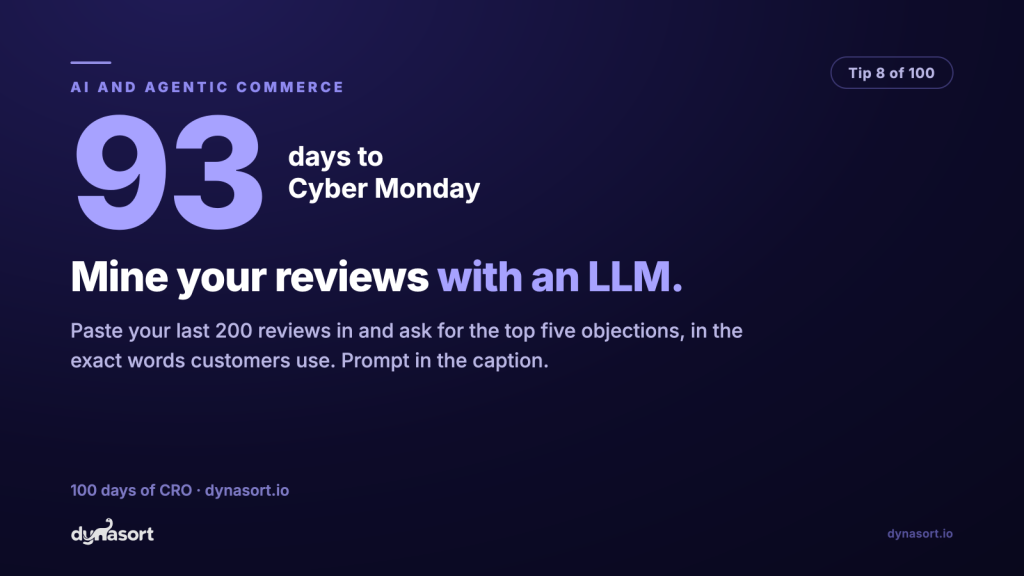
Paste your last 200 product reviews into an LLM and ask for the top five objections and the exact words customers use. Ten minutes of work, and you walk away with the market research agencies charge five figures for: a ranked list of why people hesitate, written in the vocabulary that will dissolve the hesitation.
Here is the thing about product copy: you wrote yours from inside the building. You say “premium full-grain leather”; your customers say “doesn’t scratch when my dog jumps on it.” Those are different languages, and shoppers only buy in their own. Your reviews, support tickets, and Q&A are a corpus of thousands of sentences in customer-native language, and until about two years ago, reading all of it was an intern-week. Now it is one paste.
Export reviews from your review app (Loox, Judge.me, and the rest all have CSV export), grab the most recent 200 or so including the 2-star and 3-star ones, which are the most honest documents your business produces, and feed them to ChatGPT, Claude, or Gemini with the prompt below.
The prompt
Copy, paste, replace the placeholders. Works in any major LLM.
If 200 reviews exceed the chat’s paste limit, split into two batches and ask it to merge the findings at the end.
What to do with the output
- Answer the top objection on the PDP, above the fold. If fifteen reviews say “worried it would run small,” your size section just wrote itself: “Runs true to size, say 94% of reviewers.”
- Put the stolen language into bullets and headlines. Customer phrasing consistently outperforms brand phrasing because it sounds like the voice in the shopper’s own head.
- Route objections you cannot copy-write away (real product flaws, shipping speed) to the operations to-do list. The analysis does not care whose department the problem belongs to. That is a feature.
One caveat: the model summarizes what you give it. Feed it only five-star reviews and it will cheerfully report that everything is wonderful. The 2-star reviews are where the objections live, so make sure they are in the paste. Rerun the exercise quarterly; objections drift as your product, price, and audience do.