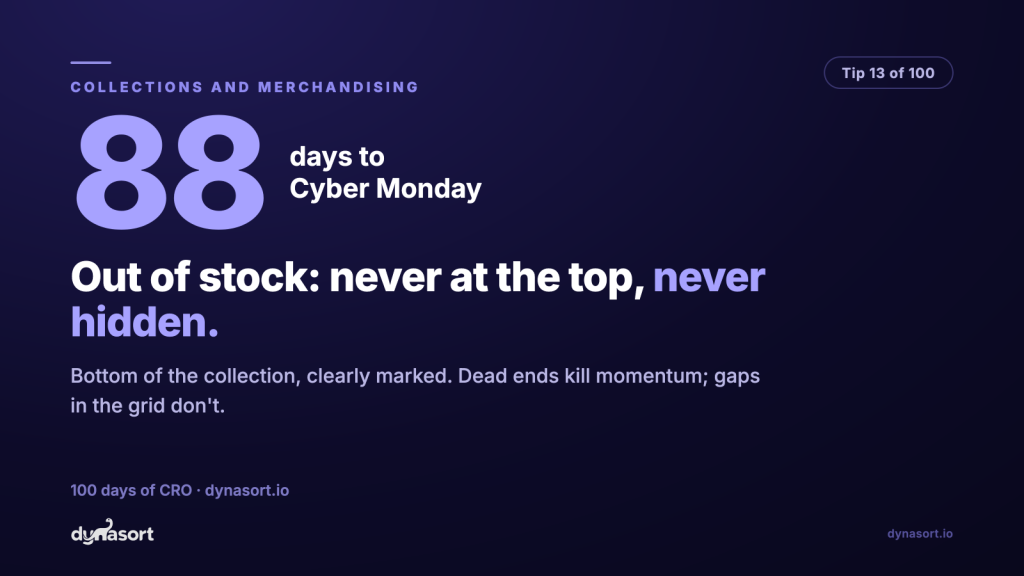
Out-of-stock products on a Shopify collection page belong in exactly one place: the bottom, visible and clearly marked. Not squatting at the top where they burn your best real estate, and not hidden entirely. Both popular strategies are wrong, and both cost money in different ways.
A sold-out product at the top of a collection is worse than an empty slot. An empty slot wastes attention; a sold-out bestseller spends it, gets the click, builds a little desire, then slams the door. Do that twice to the same shopper and they conclude the whole store is picked over. That impression, “nothing here is actually available,” is the real cost, and it discounts every in-stock product on the page.
So why not just hide them? Three reasons. Shoppers arrive from Google, old links, and shares expecting that product; a vanished page is a dead end with your name on it. A visible “sold out” is also proof that things sell here, quiet social proof you paid inventory to earn. And a marked sold-out card can still work: a back-in-stock signup on it converts disappointment into a future sale and hands you demand data for the reorder.
Same products, opposite message
Top rows are the shop window. What sits there is what the store is saying about itself.
Everything stays on the page. Only the order changes, and the order is the message.
This is not a taste call; it is the single best-supported move in our own data. When we analyzed the sorting recipes running across our platform, collections that demote sold-out products converted 56 percent above the sorted-fleet average, the strongest effect of any rule we measured. The full breakdown is in our sorting study.
Making it stick
The catch is that inventory does not hold still. The collection you tidy on Tuesday has new sellouts by Friday, and in Q4 by dinnertime, so this has to be a standing rule, not a chore. Shopify’s built-in sorts will not do it for you: “best selling” happily parks sold-out heroes at the top indefinitely. Either calendar a weekly manual demotion pass or hand the rule to automation; keeping sold-out items pinned to the bottom around the clock is precisely the job we built Dynasort for. Add a clear “Sold out” badge on the card, a back-in-stock button on the product page, and the machine quietly stops the bleeding while you restock.
One exception worth knowing: a product briefly low in stock, not out, deserves the opposite treatment. Scarcity that is still buyable sells. That nuance gets its own tip when Q4 inventory pressure is real.