The best Shopify merchandising apps in 2026 are Dynasort, KX by Kimonix, Boost AI Search & Filter, Bestsellers reSort, ST Product & Collection Sort, Sort’d, Entaice, and Searchspring, and the right one depends on which job you are hiring for. Collection sorting, site search, product recommendations and variant ordering are different problems, and most apps only do one of them well. This guide compares all eight honestly: what each does, what it costs, and the trade-offs the marketing pages leave out.
Full disclosure before we start: Dynasort is our app, and it is on this list. So you can trust the rest of the page, every entry including ours gets the same treatment.
- Merchandising on Shopify spans four surfaces: collections, search results, recommendations and product options. Most apps cover one.
- Only Dynasort covers all four from one rule set; Kimonix goes deepest on collections alone; Boost is a search product with merchandising controls.
- Pricing models differ more than prices: flat monthly plans do not grow with your sales, order-volume and product-count plans do.
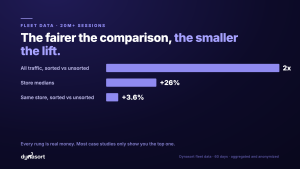
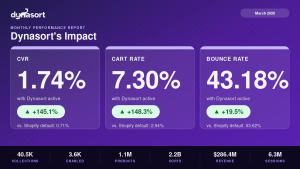
- Across stores running Dynasort, sorted collections converted 92.65% better than default Shopify sorting in June 2026 (methodology linked below).
What Does a Shopify Merchandising App Actually Do?
A Shopify merchandising app decides which products appear first. Shopify decides what appears on each surface: which products are in the collection, which match the search, which get recommended. The app controls the order. Since the top rows of any grid absorb most of the clicks, that ordering decision is quietly one of the highest-leverage settings in a store: in our study of 188,000 storefront search clicks, 28.5% went to position 1 and roughly half never went past the top three results.
Which Apps Cover Which Surfaces?
The Eight Best Shopify Merchandising Apps, Reviewed
1. Dynasort
The job: all four surfaces from one set of rules. Collections, product options and swatches, search result re-ranking, and recommendations are ordered by “recipes” you build from 40+ weighted signals: sales, inventory, margin, review ratings, freshness, metafields and more.
Standout: breadth plus transparency. One recipe logic runs everywhere, you can read exactly why a product ranks where it does, and collection analytics ship on every plan. Search and recommendations rank live on every request; collections re-sort as often as every 10 minutes on Enterprise (20 on Pro, 30 on Basic). Built for Shopify certified.
Pricing: flat plans at $99, $249 and $499 per month sized by catalog, with a 30-day free trial. No order-volume component, so the bill does not climb with your sales.
To be fair: we are the newer entrant. Our review count is small next to incumbents that have been in the App Store for years, and if all you want is a one-collection drag-and-drop tidy-up, we are more tool than you need.
2. KX AI Collection Merchandising (Kimonix)
The job: collection sorting and smart collection building, plus email-linked recommendations.
Standout: depth on the collection problem, ranking on a large number of signals, and an unusually strong library of named case studies. If you want to read stories from stores like yours before installing anything, Kimonix publishes more of them than anyone in this category.
Pricing: free entry tier, then paid tiers that scale with your store’s order volume. [VERIFY current tiers]
To be fair: collections update on a schedule measured in hours, up to a few times per day, not minutes, which matters during fast sellouts and flash sales. There is no product option or swatch sorting, and it is not a Built for Shopify certified app. Our Dynasort vs Kimonix page holds the full side-by-side.
3. Boost AI Search & Filter
The job: search and filtering first, with merchandising controls layered on top of search results and filtered collection views.
Standout: mature, widely installed search product with strong filter building. If broken storefront search is your main complaint, Boost is a serious candidate, and its merchandising rules (pin, boost, demote) live inside that search experience.
To be fair: it is a search app that merchandises, not a merchandising app. Collection sorting outside the search-and-filter context and variant ordering are not the focus, and replacing your theme’s native search UI is a bigger integration than an API-based sorter. Pricing scales with product count. [VERIFY current tiers] Full comparison: Dynasort vs Boost.
4. Bestsellers reSort (EGNITION)
The job: budget rule-based collection sorting: push bestsellers up, push sold-out products down, on a schedule.
Standout: simplicity and price. The rules are easy to reason about, the app has done this one job for years, and there is a free plan. [VERIFY tiers]
To be fair: single-metric rules rather than weighted blends, no search, recommendations or option sorting, and no analytics to tell you whether the sort actually helped. Fuller treatment in our Bestsellers reSort alternative guide.
5. ST: Product & Collection Sort
The job: data-driven collection sorting on a budget, including push-down of sold-out items and promotion of new products. Good value for stores that want more than one signal without enterprise pricing. To be fair: primarily a collection tool; search and recommendations need other apps. [VERIFY current feature set]
6. Sort’d Prime Collection Sort
The job: hands-on collection management: drag-and-drop curation with rules to automate the rest. Merchandisers who want to hand-place hero products and automate below them like this model. To be fair: manual-first is also the ceiling: the more collections you run, the more the drag-and-drop becomes the bottleneck the automation was supposed to remove. See Dynasort vs Sort’d.
7. Entaice AI Collection Sort
The job: automated collection sorting designed to keep working when shoppers apply filters. The filter-aware angle is the standout: sorted order holds inside filtered views. To be fair: a narrower feature set than the other sorters here, and a smaller track record.
8. Searchspring (Enterprise)
The job: search, merchandising and recommendations as a managed enterprise platform: one vendor for the whole discovery stack with onboarding services, which large teams value. To be fair: enterprise pricing, contracts and implementation timelines. If you are not doing enterprise volume, this category (Searchspring, Nosto, Algolia and friends) is more platform than a Shopify store needs. Trade-offs on our comparisons hub.
Flat Pricing or Usage Pricing: Which Costs More?
The sticker price matters less than the pricing model. Flat monthly plans (Dynasort, reSort, Sort’d) cost the same in your best month as your worst. Order-volume plans (Kimonix) and product-count plans (Boost) grow as you grow, which is painless at install time and noticeable a year later. Neither is wrong, but know which curve you are signing:
How Do You Choose the Right Merchandising App?
Three questions settle it. Which surface is bleeding? If search is broken, start with a search-first tool. If collections are stale, start with a sorter. If you want all four surfaces governed by one logic, that is the case Dynasort was built for. Does pricing scale with your success? See above. Can you see why it ranked what it ranked? Black-box ordering is fine until a bestseller lands on page 3 and nobody can say why. Prefer tools that show their reasoning, whichever tool that is.
Frequently Asked Questions
Do merchandising apps slow down my store?
API-based sorters (Dynasort, Kimonix, reSort) reorder through Shopify’s own system, so the storefront serves exactly as fast as before. Search-replacement apps add their own frontend, which is usually fast but is real added surface area.
Does automated sorting actually lift conversion?
Across stores running Dynasort, sorted collections converted 92.65% better than default Shopify sorting in our June 2026 performance report, methodology included. Your store is not an average, which is why we would rather you run the 30-day trial and read your own numbers.
Can I just use Shopify’s built-in sort options?
You can, and for small catalogs “Best selling” is a reasonable default. Its limits (black-box logic, no inventory awareness, cold-start burial of new products) are covered in our guide to sorting collections by best selling.
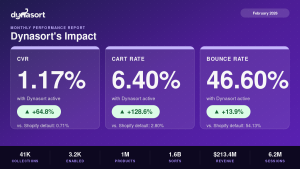
Data referenced: Dynasort June 2026 performance report, 30 days of storefront search behavior (188k clicks). Competitor facts from public App Store listings and vendor sites, August 2026; re-verify pricing before relying on it.
Dynasort merchandises collections, options, search and recommendations from one set of rules. Install it from the Shopify App Store or see how it works.