Loading...

AI & Agentic Commerce Conversion Rate Optimization

Use an LLM as a CRO Consultant for Your Product Pages

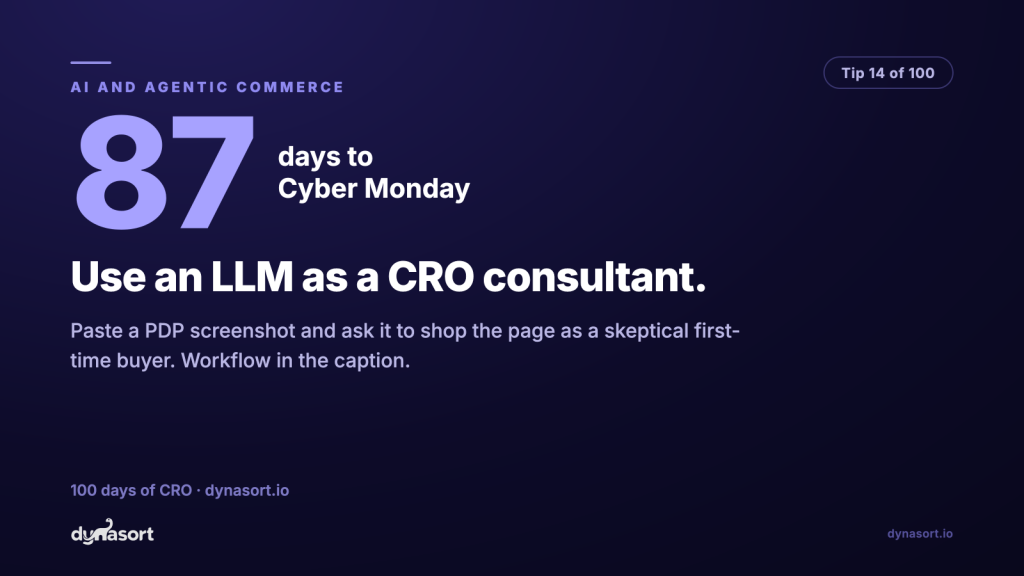
Use an LLM as a CRO consultant: paste a PDP screenshot and ask it to shop the page as a skeptical first-time buyer. Workflow included.
← All 100 tips  ·  Tip 14 of 100  ·  87 days to Cyber Monday

Use an LLM as a CRO consultant: screenshot your product page, paste it into ChatGPT, Claude, or Gemini, and ask the model to shop it as a skeptical first-time buyer. Ten minutes, zero dollars, and you get the one thing nobody on your team can give you: a first impression. You have looked at your PDP a thousand times. You literally cannot see it anymore.

To be clear about what this is and is not: it is not an audience, and it will not replace watching real sessions or running real tests. What it is exceptional at is fresh-eyes work: spotting the missing shipping answer, the buried size chart, the benefit your headline forgot to claim, the seventeen competing links above the buy button. The stuff a good consultant flags in the first five minutes of a teardown, before they start charging you for the rest of the day.

The workflow

  • Screenshot like a shopper, not a designer. Full-page capture of the live PDP on a phone-width window, because that is how most buyers meet it. Include what loads first as its own shot: the above-the-fold view is a separate exhibit.
  • Pick your hardest product, not your best. The bestseller converts despite its page. Run the teardown on the product with traffic but weak add-to-cart, the one your tip 11 funnel flagged.
  • Paste the screenshots with the prompt below. Then, and this matters, push back on two of its findings and ask it to defend them. The second round is reliably sharper than the first.
.ds-t014-wrap{max-width:760px;margin:36px auto;font-family:-apple-system,BlinkMacSystemFont,’Segoe UI’,Arial,sans-serif} .ds-t014-box{background:#f8f9ff;border:1px solid #e4e2f5;border-radius:14px;padding:26px 28px} .ds-t014-title{font-size:15px;font-weight:800;letter-spacing:.08em;text-transform:uppercase;color:#4F46E5;margin:0 0 4px} .ds-t014-sub{font-size:14px;color:#6b7280;margin:0 0 18px;line-height:1.5} .ds-t014-prompt{background:#12102e;color:#e8e6f6;border:1px solid #2c2a52;border-radius:10px;padding:20px 22px;font-family:ui-monospace,SFMono-Regular,Menlo,Consolas,monospace;font-size:13px;line-height:1.65;white-space:pre-wrap;word-wrap:break-word} .ds-t014-foot{font-size:13px;color:#6b7280;margin:16px 0 0;line-height:1.55}

The prompt

Attach your full-page and above-the-fold screenshots, then paste this.

You are a skeptical first-time shopper with a full-price budget and zero loyalty to this brand. You landed on this product page from an ad. Attached are screenshots: the above-the-fold view and the full page. The product is [PRODUCT], priced at [PRICE], and my target customer is [ONE-LINE CUSTOMER DESCRIPTION]. Shop this page honestly: 1. FIRST 3 SECONDS: From the above-the-fold shot only, what do you know, what do you doubt, and would you scroll or leave? Why? 2. THE FIVE DOUBTS: List the 5 biggest hesitations this page leaves unresolved (fit, quality, shipping, returns, “is this worth $X”, trust). For each, quote or describe the exact spot where the page should have answered it and didn’t. 3. FRICTION INVENTORY: Everything that slows the path to add-to-cart: cluttered sections, competing links, buried information, weak photo order, vague copy. Be specific about location. 4. WHAT’S WORKING: The 3 strongest elements. Do not flatter me, pick only what genuinely earns its place. 5. THE REWRITE: My 5 highest-impact fixes, ranked by expected effect on add-to-cart rate, each with a concrete suggestion I could implement this week. Rules: judge only what is visible in the screenshots, say “cannot tell from the screenshot” when true, and grade like a shopper spending their own money, not like a designer admiring craft.

Replace the bracketed placeholders before sending. Rerun the same prompt after your fixes ship; the delta between teardowns is your progress report.

Two habits make this compound. First, run the identical prompt on a competitor’s PDP for the same kind of product; the side-by-side tells you which doubts your whole category leaves open, and answering those is free positioning. Second, treat every finding as a hypothesis, not a verdict. The model saying “the guarantee is invisible” is a reason to test moving the guarantee, and you already know from tip 7 how to run that test without fooling yourself.
← All 100 tips  ·  Tomorrow, tip 15: the cheapest Black Friday traffic you will ever get, and why building it starts this week.