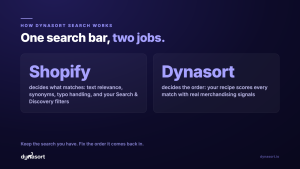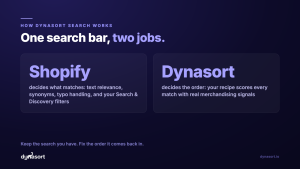
The best Shopify search apps split into two kinds: replacements like Boost, Searchanise, Klevu, Algolia and Fast Simon, which take over both matching and the results interface, and re-rankers like Dynasort, which leave matching to Shopify and control the order of what it returns. Shopify’s own free Search & Discovery is the baseline both build on. Which kind you need depends on whether your problem is finding or ranking, and this guide sorts that out honestly, native option included.
- Diagnose first: a high zero-result rate means a matching problem (replacement territory); poor ordering of decent matches means a ranking problem (re-ranking territory).
- Search visitors convert at a multiple of browsers; measure your own store’s gap before buying anything.
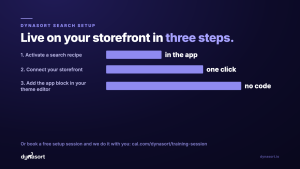
- Replacements add their own frontend to your theme; re-rankers change no storefront code.
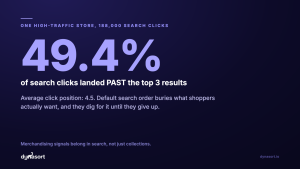
- In our 188k-click study, 28.5% of search clicks went to position 1 and roughly half never passed the top three: order is most of the game.
What Does Shopify’s Native Search Already Do?
Shopify Search & Discovery is free and better than its reputation: synonym groups, product boosts, filters, and query handling that improves every year. For a small catalog with clean product data it is often enough. Its limits are ranking limits: results cannot be ordered by your sales, margins or inventory, boosts are hand-picked per product rather than data-driven, and sold-out products keep their positions. [VERIFY current S&D feature list before publish]
Replace or Re-Rank: Which Kind of Search App Do You Need?
The diagnosis is measurable. Check your zero-result rate: if a meaningful share of searches return nothing (or garbage), matching is your problem and a replacement earns its complexity. If results are relevant but badly ordered, sold-out items up top, bestsellers on page two, that is a ranking problem, and measuring your search conversion against browse conversion tells you what the fix is worth.
The Best Shopify Search Apps, Reviewed
1. Shopify Search & Discovery (free, native)
The baseline. Synonyms, boosts, filters, zero cost, zero added scripts. Start here, and only spend money once you can name the problem it is not solving.
2. Dynasort (re-ranker)
Keeps Shopify’s matching and re-ranks every result set live on each request by your recipe: sales velocity, inventory (sold-out sinks or hides, restocks return automatically), margin, reviews, newness. Same rules run your collections and recommendations, so one logic governs the store. Flat pricing, 30-day trial, Built for Shopify certified. To be fair: if your matching is broken (heavy typos, cross-language queries, zero-result floods), re-ranking cannot fix what never matched; that is replacement territory, and we say so in our search comparison.
3. Boost AI Search & Filter
The most established replacement in the App Store: instant search, typo tolerance, deep filter building, merchandising rules inside results. To be fair: it replaces your theme’s search UI, pricing scales with product count [VERIFY], and its collection merchandising lives inside the search-and-filter context. Head-to-head: Dynasort vs Boost.
4. Searchanise
A long-running replacement with smart search pages and custom filters at aggressive pricing. [VERIFY tiers] To be fair: the widget look takes theme work to feel native, and merchandising controls are lighter than Boost’s.
5. Algolia
Search infrastructure with genuine speed and typo tolerance, popular with development teams that want API-level control. To be fair: it is a platform you build with, not an app you switch on; budget for implementation, and query-volume pricing needs watching. Our Dynasort vs Algolia page covers when each makes sense.
6. Klevu
Replacement with strong natural-language handling and self-learning ranking, positioned upmarket. [VERIFY current Shopify offering and pricing] To be fair: enterprise-leaning pricing for what many stores need.
7. Fast Simon
Replacement bundling search with merchandising and personalization features. [VERIFY] To be fair: the bundle is broad rather than deep in places; compare the specific features you need. See Dynasort vs Fast Simon.
8. The enterprise tier
Searchspring, Nosto and friends sell search inside a managed discovery platform with services attached. Right for enterprise volume and teams; more platform than most Shopify stores need.
How Do You Choose a Search App?
Measure before you shop: your zero-result rate names the problem, and your search-vs-browse conversion gap prices the fix. Matching problem: pick a replacement (Boost first look, Searchanise on budget, Algolia with a dev team). Ranking problem: pick a re-ranker and keep your theme untouched. Both problems: fix matching first; ranking polish on results nobody gets is wasted. And whatever you install, re-test the zero-result rate and the conversion gap after four full weeks.
Frequently Asked Questions
Is Shopify’s built-in search good enough?
For small catalogs with clean product data, often yes. Spend money only when you can name the failure: searches returning nothing, or good matches badly ordered.
Do search apps slow down the storefront?
Replacements add their own scripts and UI; the good ones are fast, but it is real added surface area. Re-rankers change the order server-side with no storefront scripts, so speed stays exactly as it was.
What is search relevance, actually?
Two separate things bundled in one word: whether the right products match the query at all, and whether the best of those matches appear first. Apps that improve one do not automatically improve the other, which is exactly the replacement-versus-re-ranker split.
Data referenced: 30 days of storefront search behavior (188k clicks). Competitor facts from public listings, August 2026.
Dynasort re-ranks your Shopify search results by what sells, live on every request. Install it from the Shopify App Store or see search re-ranking in action.