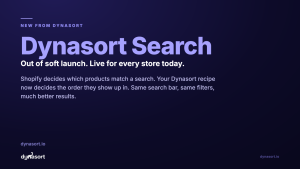
Since we launched Dynasort Search on Monday, the most common question has been some version of “how is this different from Algolia?” or Searchanise, or Boost, or whichever search app a merchant already knows. Fair question. Here is a direct answer, built from each vendor’s own listing, pricing page, or documentation.
How to use this comparison: these are good products with different architectures, and the right choice depends on what you need. If you need typo-tolerant instant search, visual search, or per-shopper personalization, some of the apps below do those things and we do not. If you want merchandising control over the order of results without migrating your search stack, that is what we built. We sell a specific architecture, not a claim that the alternatives are bad.
The one structural difference
Almost every dedicated search app for Shopify works the same way at the foundation: it syncs your catalog into its own search index and serves results from its own engine. That is a deliberate and reasonable design. Owning the index is what buys these vendors true typo-tolerant instant search, semantic matching, and features Shopify’s engine does not offer.
It also has costs, documented in the vendors’ own materials: a second index that has to stay in sync (Searchanise re-indexes products on a 10-minute cycle and asks for manual re-indexation of collections and pages after edits; Klevu’s delta sync runs roughly every 10 minutes; Fast Simon’s Starter plan documents hourly synchronization), synonyms managed in the vendor’s dashboard rather than in Shopify Search & Discovery, and in Algolia’s case, setup instructions that explicitly say to turn off the default Shopify search results in the theme.
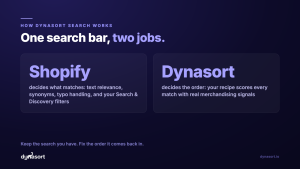
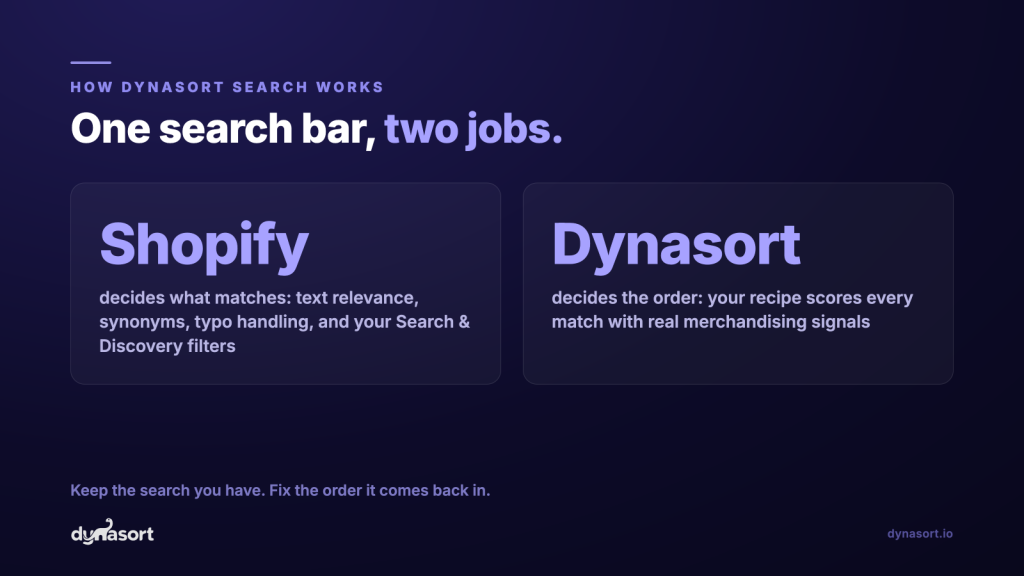
Dynasort takes the opposite bet. Shopify’s engine keeps deciding which products match a query, so your synonyms, Shopify’s typo handling, and your Search & Discovery filters all keep working, and there is no second index to sync. Dynasort re-ranks the matched set on the results page and in the predictive dropdown, using the same merchandising recipes that already run your collections: sales velocity, inventory, newness, margin, and your own custom attributes. One recipe engine covers four surfaces (collections, search, recommendations, and post-purchase upsells), with built-in A/B testing and per-serve tracking to prove what a change did.
The comparison table
| App | What drives ranking | Replaces Shopify search index? | Filters | Surfaces covered | A/B testing | Entry price |
|---|---|---|---|---|---|---|
| Dynasort | Merchandising recipes re-rank Shopify’s matches (sales velocity, inventory, margin, newness, custom attributes) | No, keeps it | Shopify S&D filters keep working | Collections, search, recommendations, post-purchase | Yes | $99/mo, 30-day trial |
| Algolia | Own relevance engine, AI ranking, custom ranking rules, boosts | Yes, own index | Own facets | Search, collections, recommendations | Yes | Free tier; usage-based billing |
| Searchanise | Own instant-search engine, “personalized AI search”, merchandising tools | Yes, own index | Own, unlimited | Search, filters, recommendations | Not advertised | Free under 25 products; $19/mo |
| Boost AI Search & Filter | Own AI search plus merchandising campaigns (pin, boost, demote) | Yes, own index | Own filter trees | Search, filters, collection merchandising, recommendations | Not advertised | From $29/mo, GMV-scaled |
| Fast Simon | Own AI relevance (text and image) plus per-shopper personalization | Yes, own platform | Own | Search, filters, category merchandising, recommendations, upsell | Yes | Free tier; $39.99/mo, session-metered |
| Klevu | Own AI and NLP engine, personalization, visual merchandising | Yes, own index | Own | Search, category merchandising, recommendations (separate modules) | Yes (recommendations) | $449 to $649/mo per module |
| Kimonix | Merchandising parameters (revenue, conversion, margin, inventory) | No for collections; own conversational search layer | Not a filter app | Collections, recommendations, conversational search | Yes | $19/mo |
| Sparq | Own AI text relevance, typo tolerance, synonyms | Yes, own index | Own, unlimited | Search and filters | Not advertised | $19/mo |
| Doofinder | Own AI semantic search, “searchandising” tools, boosts | Yes, own index | Own multi-filter system | Search, filters, recommendations, quiz | Not advertised | $61/mo |
Sources: each vendor’s public Shopify App Store listing, pricing page, or documentation, accessed Aug 24 2026. Pricing and features change; corrections welcome at hello@dynasort.io.
The apps, one at a time
Algolia is the enterprise search platform of the group, with its own relevance engine, AI ranking, synonym groups, custom ranking rules, and A/B testing. Its Shopify setup syncs products into Algolia’s index and has you turn off the native search results section, with synonyms and ranking managed in the Algolia dashboard. Pricing is usage-based rather than flat tiers, with a free tier up to 10K searches a month. If you want fine-grained relevance engineering, it is the deepest toolset here.
Boost AI Search & Filter is one of the most-installed options, with 1,498 App Store reviews at 4.8 stars. It pairs its own AI search with merchandising campaigns (pin, boost, demote, visual rules) and configurable filter trees, plus per-shopper personalized search on its top tier. Pricing scales with store GMV, starting at $29/mo. A/B testing is not an advertised feature.
Searchanise has been around since 2015 and holds 4.8 stars across 1,071 reviews. It runs search from its own servers with instant-search widgets, unlimited filters, and merchandising tools, priced from free under 25 products and $19/mo after that. Products re-index automatically every 10 minutes; collections, pages, and blog posts need manual re-indexation after edits.
Fast Simon is the broadest own-index platform in this set: AI search across text and image, per-shopper personalization that adapts results to each visitor, visual merchandising tools, filters, recommendations, and upsell, plus A/B testing for merchandising rules. It carries the Built for Shopify badge. Pricing is session-metered from a free 100-session tier, and the Starter plan syncs data to its index hourly.
Klevu sells modular products: Site Search at $649/mo, Category Merchandising at $549/mo, and Recommendations at $449/mo, each usage-metered. In exchange you get an AI and NLP engine with a personalization layer, a visual merchandising dashboard, and A/B testing for recommendations. Its breadth is the closest to Dynasort’s four surfaces, assembled from separately priced modules on Klevu’s own index.
Kimonix is the closest architectural relative to Dynasort: a merchandising-first app that sorts Shopify collections natively rather than replacing search, ranking on 100-plus parameters like revenue, conversion, margin, and inventory, with collection A/B testing built in. Its plans cap re-sorts at 1 to 4 updates per day and cap collection counts per tier, and its search product is a conversational shopping-assistant layer rather than a re-rank of Shopify’s search matches. At $19/mo entry and a 5.0-star rating over 198 reviews, it is a strong choice for collection-focused merchandising.
Beyond the majors: Sparq ($19/mo) and Doofinder ($61/mo, 741 reviews at 4.7 stars) are own-index search and filter apps, with Doofinder adding semantic search, voice and image search, and recommendation carousels. Layers is a semantic search and merchandising platform built exclusively for Shopify Plus, sold direct on custom quotes with near-real-time indexing and visual discovery. Searchmind is an agentic semantic search platform, also quote-priced and integrated with Shopify directly rather than through an App Store listing. All four replace the Shopify search index with their own.
Where the replace-the-engine approach is stronger
Honesty section. Because own-index vendors control matching, they can offer things we structurally cannot:
- True typo-tolerant instant search. Dynasort inherits Shopify’s matching behavior, whatever it is. Own-index engines tune their own.
- Semantic and visual search. Layers, Doofinder, Fast Simon, and Searchmind offer image or intent-based search. We have nothing comparable.
- Per-shopper personalization. Boost, Fast Simon, Klevu, Doofinder, and Algolia offer 1:1 personalized results. Dynasort recipes rank for the store, not per individual shopper.
- Filter depth and visual editors. Boost, Searchanise, Sparq, and Fast Simon are as much filter products as search products, and several vendors ship drag-and-pin visual merchandising dashboards. We lean on Shopify Search & Discovery for filters by design.
- Track record. Boost, Searchanise, and Doofinder each have hundreds to thousands of reviews. Dynasort Search shipped this week.
If any of those is the thing you need, choose accordingly. They are real capabilities and the vendors above have earned their reputations.
Where Dynasort fits
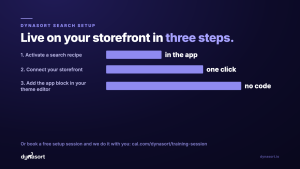
Dynasort is for merchants who like how Shopify’s search matches products and want control over the order it puts them in, without adopting a second index, a second synonym dashboard, or a migration project. You get one automated ranking brain across collections, search results, the predictive dropdown, recommendations, and post-purchase upsells, driven by business signals you choose, measurable with built-in A/B testing and per-serve tracking. Setup is theme-editor only, no code, and pricing is flat: $99, $249, or $499 per month with a 30-day free trial.
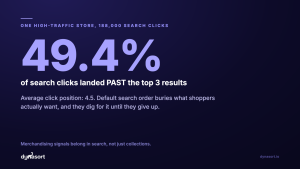
Two architectures, two bets. The own-index apps bet that better matching wins. We bet that for most stores, Shopify’s matching is already good, and the ordering is where the money is.
Install Dynasort free for 30 days or read the search docs. Want a walkthrough instead? Book a free setup session and we will compare notes on your current search stack too.
We also published a broader, vendor-neutral version of this comparison: the best Shopify search apps, replace or re-rank.